
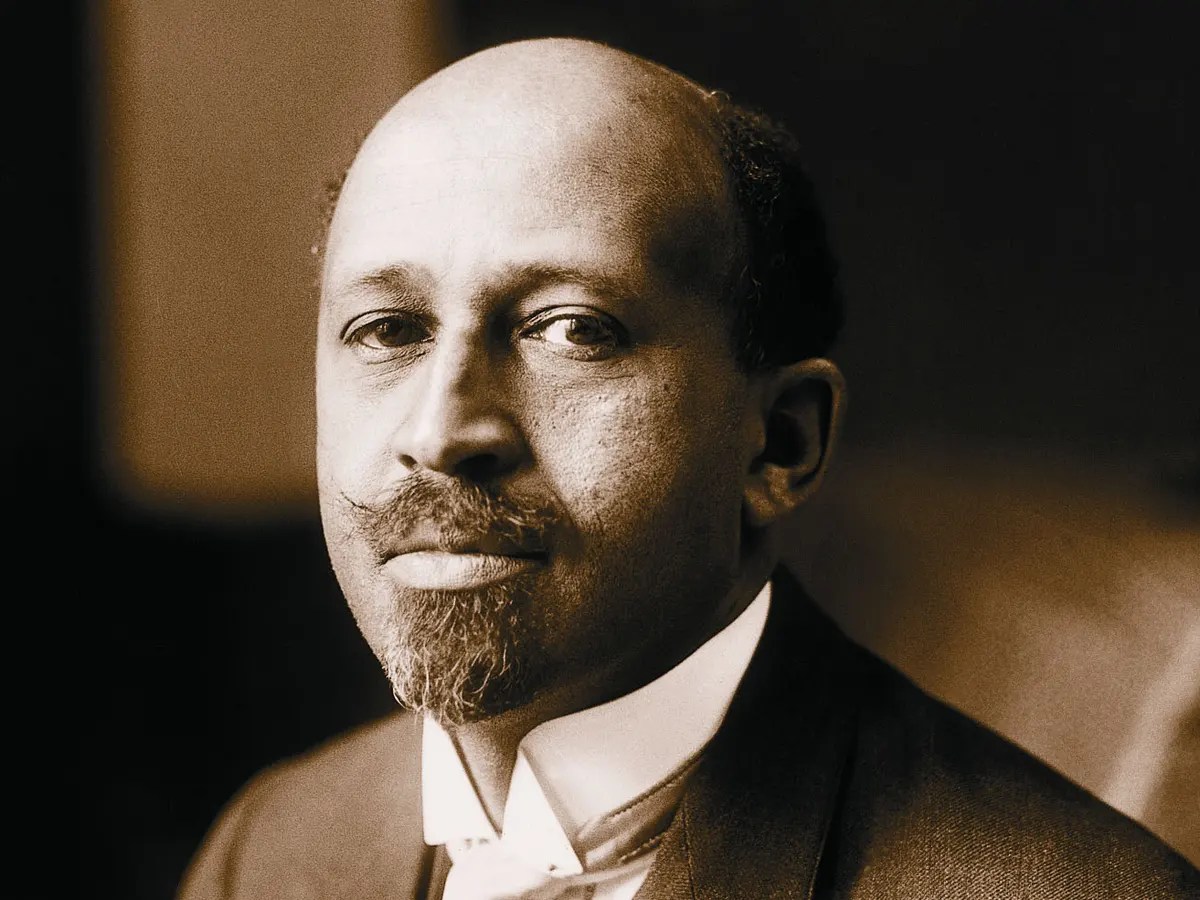
Welcome to the “Black History Month” edition of the Evolving Man Project’s Evolved Man of the Week profiles. Each week in February, we will highlight a historical black male figure who embodies what it means to be an evolved, famous, and non-famous man. The world needs to know their stories and deeds. This week’s honor goes to the author, American sociologist, socialist, historian, and Pan-Africanist civil rights activist William Edward Burghardt (W.E.B.) DuBois.
William Edward Burghardt DuBois was born on February 23, 1868, in Great Barrington, Massachusetts, to Alfred and Mary Silvina (née Burghardt) DuBois. Mary Silvina Burghardt’s family was part of Great Barrington’s tiny free black population and had long owned land there. She was descended from Dutch, African, and English ancestors. William DuBois’s maternal great-great-grandfather was Tom Burghardt, a slave (born in West Africa around 1730) held by the Dutch colonist Conraed Burghardt. Tom briefly served in the Continental Army during the American Revolutionary War, which may have been how he gained his freedom during the late 18th century. His son Jack Burghardt was the father of Othello Burghardt, who in turn was the father of Mary Silvina Burghardt.
DuBois initially attended Fisk University in Nashville, Tennessee, a school for Black students. His tuition was paid by several churches in Great Barrington. DuBois became an editor for the Herald, the student magazine. After graduation, DuBois attended Harvard University, starting in 1888 and eventually receiving advanced degrees in history. In 1892, DuBois worked towards a Ph.D. at the University of Berlin until his funding ran out.
He returned to the United States without his doctorate. Still, he later received one from Harvard while teaching classics at Wilberforce University in Ohio. He married Nina Gomer, one of his students, in 1896. His doctoral thesis, “The Suppression of the African Slave Trade to the United States of America, 1638–1870,” became his first book and a standard in American education covering slavery.
Although DuBois had believed initially that social science could provide the knowledge to solve the race problem, he gradually came to the conclusion that in a climate of virulent racism, expressed in such evils as lynching, peonage, disfranchisement, Jim Crow segregation laws, and race riots, social change could be accomplished only through agitation and protest. In this view, he clashed with the most influential Black leader of the period, Booker T. Washington, who, preaching a philosophy of accommodation, urged Blacks to accept discrimination for the time being and elevate themselves through hard work and economic gain, thus winning the respect of whites. In 1903, in his famous book The Souls of Black Folk, Du Bois charged that Washington’s strategy, rather than freeing the Black man from oppression, would only perpetuate it. This attack crystallized the opposition to Booker T. Washington among many Black intellectuals, polarizing the leaders of the Black community into two wings—the “conservative” supporters of Washington and his “radical” critics.
Two years later, in 1905, DuBois took the lead in founding the Niagara Movement, which was dedicated chiefly to attacking the platform of Booker T. Washington. The small organization, which met annually until 1909, was seriously weakened by internal squabbles and Washington’s opposition. But it was significant as an ideological forerunner and direct inspiration for the interracial NAACP founded in 1909. DuBois played a prominent part in creating the NAACP. They became the association’s director of research and editor of its magazine, The Crisis. In this role, he wielded an unequaled influence among middle-class Blacks and progressive whites as the propagandist for the Black protest from 1910 until 1934.
DuBois took a trip around the world in 1936, which included visits to Germany, China, and Japan. While in Germany, DuBois remarked that he was warmly welcomed and respected. After his return to the United States, DuBois expressed his ambivalence about the Nazi regime. He admired how the Nazis had improved the German economy. Still, he was horrified by their treatment of the Jewish people, which he described as “an attack on civilization, comparable only to such horrors as the Spanish Inquisition and the African slave trade.”
The magazine was a huge success and became very influential, covering race relations and black culture with Du Bois’ forthright style. The magazine stood out for its continual endorsement and coverage of women’s suffrage. Du Bois worked for the NAACP for 24 years, when he published his first novel, The Quest of the Silver Fleece.
After a brief second stint at Atlanta University, Du Bois returned to the NAACP as director of special research in 1944. They represented the organization at the first United Nations meeting. DuBois also became more interested in communism and international issues. He openly supported progressive and left-wing groups, which created problems with NAACP leadership. He left the organization again in 1948.
Identified with pro-Russian causes, he was indicted in 1951 as an unregistered agent for a foreign power. A federal judge directed his acquittal, and DuBois had become completely disillusioned with the United States. In 1961, he applied to and was accepted as a member of the Communist Party. That same year, DuBois left the United States for Ghana, where he earnestly began work on the Encyclopedia Africana. However, it would never be completed, and where he later became a citizen.
His health declined during the two years he was in Ghana; he died on August 27, 1963, in the capital, Accra, at the age of 95.The following day, at the March on Washington, speaker Roy Wilkins asked the hundreds of thousands of marchers to honor Du Bois with a moment of silence.The Civil Rights Act of 1964, embodying many of the reforms Du Bois had campaigned for during his entire life, was enacted almost a year after his death.
“One ever feels his twoness, — an American, a Negro; two souls, two thoughts, two unreconciled strivings; two warring ideals in one dark body, whose strength alone keeps it from being torn asunder.”
― W.E.B. DuBois, The Souls of Black Folk
W.E.B. DuBois is one of the most influential black thinkers of the 20th century. He received numerous awards and honors during his life and well after his death. He lived a full and complex life, but the struggle for black liberation always guided his principles. DuBois was one of my inspirations as a young man. Like Dubois, I majored in sociology and history thanks to his influence. I was moved by the book Souls of Black Folks, and I attended an elementary school named after the legendary scholar. Today, we honor W.E.B. DuBois as our Evolved Man of the Week.

 Evolving Folks Project