
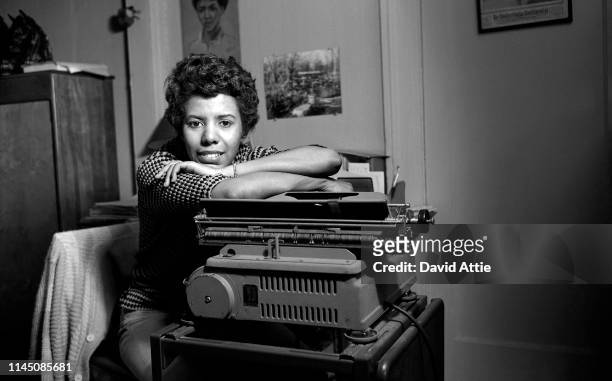
Welcome to the Evolving Man Project’s “Black History Month” edition of the O. G. profiles. The O.G. profiles will highlight women from diverse backgrounds and how they embody the values of what it means to be an evolved person. While uplifting their contributions to making a fairer and more just society. Today, we will profile Lorraine Hansberry.
Lorraine Hansberry, an American playwright and writer, was a trailblazer who significantly impacted the theater world and beyond. She was born in Chicago in 1930. While growing up, prominent figures advocating social justice and intellectual pursuits surrounded Hansberry. Her father, Carl Augustus Hansberry, fought against discriminatory housing practices through lawsuits, influencing her future playwriting. While attending high school, her love for theater began. Still, she shifted her attention to painting during her time in Chicago and Mexico.
Instead of following the family tradition of enrolling and attending Southern Historically Black colleges, Hansberry chose to attend the University of Wisconsin in Madison. She switched from painting to writing as her major in school, but she dropped out after two years and relocated to New York City.
It was 1950 when Hansberry moved to New York City. She was quickly immersed in the city’s vibrant cultural and political scene. She joined protests against racial discrimination and actively engaged in the Civil Rights movement, embracing activism. While working for the progressive newspaper “Freedom,” Lorraine honed her writing skills. She explored themes of liberation struggles faced by marginalized communities and groups. During this period, she met her future husband, Robert Nemiroff, during a protest.
She became part of the Daughters of Bilitis in 1957. She wrote letters for their magazine,The Ladder, discussing issues of feminism and homophobia. To protect herself from discrimination, she used her initials, L.H., to write the articles, but they ultimately revealed her lesbian identity.
Hansberry defied societal expectations as a lesbian woman by incorporating subtle themes of identity and expression into her work. She could navigate this part of her life with a fair amount of privacy, thanks to the social climate of the time.
Hansberry’s most celebrated work, “A Raisin in the Sun,” premiered on Broadway in 1959. This groundbreaking play became the first by an African-American woman to reach Broadway. It portrayed the difficulties and hopes of a black family in Chicago as they maneuvered through social and economic barriers. It also served as one of my favorite plays while in high school, and I watched several plays and movies based on Hansberry’s seminal work.
Her husband, Robert Nemiroff was a Jewish songwriter. The two were married in 1953. Even after their 1962 divorce, Hansberry and Nemiroff maintained a working relationship.
Lorraine Hansberry’s legacy is that of a pioneer in theater and a powerful voice for social justice. Her work resonates with audiences and inspires conversations about race, class, and pursuing dreams in the face of adversity. She was honored with numerous awards, including being the first Black playwright to win the New York Critic’s Circle award for Best American Play. Her playwriting career was unfortunately brief, but she left behind a lasting legacy. In addition to “A Raisin in the Sun,” she authored other theatrical works. She engaged in creative pursuits until her untimely passing from pancreatic cancer in 1965.
In 1999, Hansberry was posthumously inducted into the Chicago Gay and Lesbian Hall of Fame. In 2002, scholar Molefi Kete Asante listed Hansberry in the biographical dictionary 100 Greatest African Americans. The Lorraine Hansberry Theatre of San Francisco specializes in original stagings and revivals of African-American theatre and is named in her honor. Lincoln University’s first-year female dormitory is named Lorraine Hansberry Hall. There is a school in the Bronx called Lorraine Hansberry Academy and an elementary school in St. Albans, Queens, New York, named after Hansberry. On the eightieth anniversary of Hansberry’s birth, Adjoa Andoh presented a BBC Radio 4 program entitled Young, Gifted, and Black in tribute to her life.
Here is Lorraine Hansberry in her own words:
“I have come to maturity, as we all must, knowing that greed and malice and indifference to human misery, bigotry and corruption, brutality and, perhaps above all else, ignorance abound in this world.”
– Lorraine Hansberry

 Evolving Folks Project