
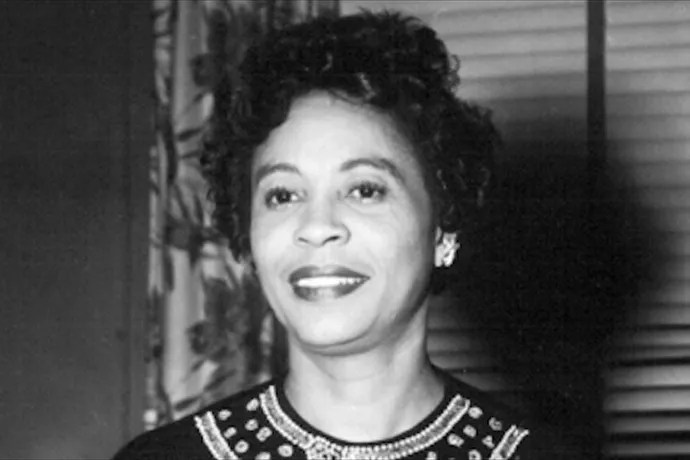
Welcome to the Evolving Folks Project’s “Evolved Woman of the Week” Black History Month Edition profile. Each week, we will highlight an individual who embodies what it means to be an evolved person, famous and non-famous alike. The world needs to know their stories and deeds. This week’s honor goes to the legendary and courageous figure in the American Civil Rights Movement, best known for her central role in the Little Rock Nine school integration crisis of 1957, Daisy Bates.
Daisy Bates was born in Huttig, Arkansas, in 1914. She faced many hardships as a child. After white men killed her mother, family friends raised her. Her adoptive father’s early prejudice against white people shaped her own views on race relations, but he later gave her important advice:
“Hate can destroy you…” Don’t hate white people just because they’re white. If you hate, make it count for something. Hate the humiliations we are living under… and try to do something about it.”
This advice guided her throughout her life. Bates went to segregated public schools in Huttig, where she saw firsthand the challenges black students faced. When she was a teenager, Orlee Smith died, leaving her with her mother. Bates admired her father and believed she married her husband because he shared similar qualities. She remembered her father always treating her as an equal in their conversations.
Daisy met Lucius Christopher Bates when she was 15, while he was still married to Kassandra Crawford. At 17, she started seeing him. Lucius had worked as an insurance salesman and as a newspaper reporter in the South and West. In 1941, he divorced his first wife, moved to Little Rock, and started the Arkansas State Press. Daisy and Lucius married on March 4, 1942.
In 1952, Daisy Bates was elected president of the Arkansas Conference of NAACP branches. She owned and ran the Arkansas State Press, a weekly African American newspaper. The paper spoke out against police brutality and segregation, becoming a leading civil rights publication in the state. It also served as a base for Bates’ activism.
As President of the Arkansas NAACP, Bates played a key role in organizing and supporting the nine Black students who integrated Central High School in Little Rock in 1957. She handled logistics, prepared the students for the hostility they would face, and worked with the NAACP and its lawyers. Despite violent protests and the Arkansas National Guard blocking their entry, she went with the students to the school. Her home became the center of planning, a safe place for students, and a focal point for media attention. Segregationists also attacked the school. The students’ courage and her strong leadership led President Eisenhower to federalize the Arkansas National Guard and send the 101st Airborne Division to protect the students and enforce the Supreme Court’s Brown v. Board of Education decision.
Daisy Bates’s influence continued long after the crisis. Her memoir, “The Long Shadow of Little Rock” (1962), won an American Book Award. She worked for the Democratic National Committee and took part in anti-poverty programs during President Lyndon B. Johnson’s administration. Later, she restarted the Arkansas State Press.
In 1986, the University of Arkansas Press published a new edition of “The Long Shadow of Little Rock.” This was the first time a reprinted book won an American Book Award. Former First Lady Eleanor Roosevelt wrote the introduction to Bates’s book. Even after selling the newspaper the following year, Bates continued to serve as a consultant. Bates died in Little Rock on November 4, 1999, at age 84, after a series of strokes.
Daisy Bates received many honors during her life and after her death. At the 1963 March on Washington, she was the only woman to speak, introducing the “Tribute to Negro Women Fighters for Freedom.” She was posthumously awarded the Congressional Gold Medal in 1999. The City of Little Rock honored her and the era she helped create by naming the School after her. The state designated the third Monday in February as George Washington’s Birthday and Daisy Gatson Bates Day, making them official state holidays. In 2019, a bill signed by Gov. Asa Hutchinson named Daisy Bates and singer Johnny Cash as Arkansas’s representatives in the Capitol’s Statuary Hall. On May 8, 2024, her statue was officially unveiled at the Capitol.
Daisy Bates will be remembered as a brave organizer, strategist, and protector. She used her influence, voice, and intelligence to drive change. She stood up to systemic racism even when it put her in danger. She was known as a determined leader whose work was vital to an important early victory in the Civil Rights Movement. Today, we honor Daisy Bates as our Evolved Woman of the Week.
 Evolving Folks Project