
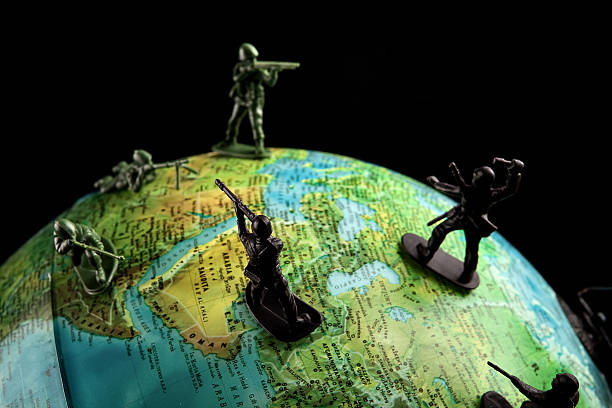
Big Green and the Cost of War
In a 2021 article, I stated that, “Earth is the only home we have, and we should treat it and each other much better.” Berkeley Earth, a California-based nonprofit research organization, concluded that 2025 was the third-warmest year on Earth since 1850. Only 2024 and 2023 exceeded it. Wildfires have ravaged Maui and Canada. Smoke from Canadian wildfires has led to orange skies and hazardous air quality from New York City and Chicago to Atlanta and Charlotte. In Baja and Southern California, they’ve dealt with tropical storms, mudslides, and hurricane-type winds. Those are just a couple of examples of the extreme weather across North America alone. This summer’s record heat has reached every continent on the planet. These extreme weather patterns tie directly to the climate crisis. But in the fight against climate change, there’s a massive elephant in the room that emits tons of carbon into the atmosphere: the U.S. Military.
The United States military is the planet’s largest single emitter of greenhouse gases and consumer of oil. – Teddy Ogborn, Common Dreams
The issue exceeds the military’s role in rising emissions. Humanity has paid dearly for endless wars. War and militarism devastate humans, animals, crops, and ecosystems. Consider how the first atomic bomb destroyed Nagasaki and Hiroshima in 1945, or the tragic deaths of soldiers and civilians in the World Wars. War’s violent legacy touches every generation.
In college, I befriended a group of philosophy grad students. One, whom I’ll call Q, recalled swimming as a child in Cambodia—not in volcanic craters, but in bomb craters left by the U.S. during the Vietnam War. Q’s story stayed with me, highlighting how the Military Industrial Complex affects many, especially in the Global South.
Millions in war zones have been displaced. U.S. post-9/11 wars forced at least 38 million people from Afghanistan, Iraq, Pakistan, Yemen, Somalia, the Philippines, Libya, and Syria—more than any conflict since 1900 except World War II. – Cost of War, Brown University.
War devastates habitats, communities, and health. Conflict leads to displacement, mass migration, and the destruction of infrastructure and the environment. Nuclear testing ruined coral reefs at Bikini Atoll; Gulf War veterans suffered from Gulf War Syndrome; U.S. veterans of Vietnam faced health risks from Agent Orange, passing congenital disabilities to future generations. Both Middle Eastern and Southeast Asian wars caused immense suffering at home and abroad. As a combat veteran, I know firsthand that there is nothing glorious about war.

This is where Big Green—prominent environmental organizations such as the Sierra Club, 350.org, Union of Concerned Scientists, Environmental Defense Fund, and Greenpeace—can address the true roots of the crisis. Yet, despite their dedication to climate action, I found no evidence that these organizations have any official anti-war policies, even though the climate crisis and warfare are deeply connected. The U.S. military budget and fossil fuel use undermine progress on climate justice, yet lawmakers cut vital social service programs while refusing to slice any military spending. To be effective, environmental organizations must recognize and confront the impact of war and militarism on the environment.
Many Big Green organizations challenged nuclear energy and weapons, yet they often miss that the atomic age—and escalating environmental destruction—are rooted in war and militarism. To truly fulfill its mission, Big Green must add an explicit anti-war stance to climate advocacy. Their influence can shift public policy away from conflict and toward planetary protection.
Protecting life and the planet is already the mission of many Big Green organizations. Taking an anti-war stance follows naturally from that mission and is within their sphere of influence. Big Green has the organizational power and credibility to advocate for diplomacy, potentially swaying political leaders to pursue peaceful solutions to conflict. If these organizations made anti-war activism central to their platform, their advocacy could prompt government officials to consider alternatives to military action, positively affecting both human and environmental well-being. To directly see the impact that war has on human life and the environment, look at the devastation caused by Israel’s assault on the Gaza Strip since 2023 as an example.
Two years of escalating conflict have caused unprecedented levels of environmental damage in the Gaza Strip, damaging its soils, freshwater supplies, and coastline, finds a new report from the United Nations Environment Programme (UNEP).
Those on the ground lose most in war. Political leaders and CEOs profit from conflict—they rarely suffer. War should always be a last resort. The military-industrial complex drains vast resources and talent. Now, with the U.S. and Israel attacking Iran, fears of a new world war are rising. After decades of U.S. conflict in the Middle East, this latest war threatens needless loss of life and environmental destruction in Iran and beyond. Bombs destroyed a girls’ school in Tehran, causing needless loss of life, and retaliatory strikes killed or injured dozens of U.S. military personnel. This conflict is only in its earliest stages, and humanity should collectively seek a diplomatic solution to ease tensions between rival nations.
Money and ingenuity are needed to tackle climate change and inequality. We should redirect funds and talent to renewable energy, high-speed rail, walkable cities, reduced plastic use, and sustainability efforts in the U.S. and worldwide. Endless war diverts resources from those who need it most—often war’s victims.
Big Green holds the power to challenge U.S. militarism as a climate issue. CODEPINK, for example, has urged over 100 environmental groups to sign on to their “War Is Not Green” campaign. More must join to connect war directly with environmental destruction. For lasting progress, Big Green must advocate for climate and peace together.
Let us heed Dr. Martin Luther King Jr.’s words and turn our belief in unarmed truth and unconditional love into collective action. By uniting for peace and protecting our planet, we have the power to create the bright daybreak of justice for generations to come. Stand up, speak out, and demand an end to war for the sake of humanity and the Earth.

 Evolving Folks Project